
WanderwiseAI · System Documentation v1.1
This Is Not a Coaching Website. It Is a Live AI System.
WanderwiseAI is a dual-purpose platform. On the surface, it is a personal brand and digital product environment for identity architecture and sovereign living. Underneath, it is a working proof-of-concept for AI-driven content delivery, automated customer journeys, and scalable digital infrastructure — built, deployed, and iterated by a single operator.
Every workflow, every automation, and every AI integration running on this site was designed and implemented from the ground up. This page documents the architecture.
The Philosophy Behind the Build
The same principles that govern The Shift methodology govern the technical architecture of this platform: precision over volume, systems over effort, and scalable design over manual repetition.
WanderwiseAI was built to answer one question — can a single operator, using AI automation and modern cloud infrastructure, build and run a fully functional digital product business without a technical team? The answer, documented here, is yes.
This environment is used as an active R&D lab to stress-test LLM integrations, autonomous workflow design, and AI-assisted content delivery — the same capabilities deployed at an organisational scale for enterprise and EdTech environments.
The Four-Layer Architecture
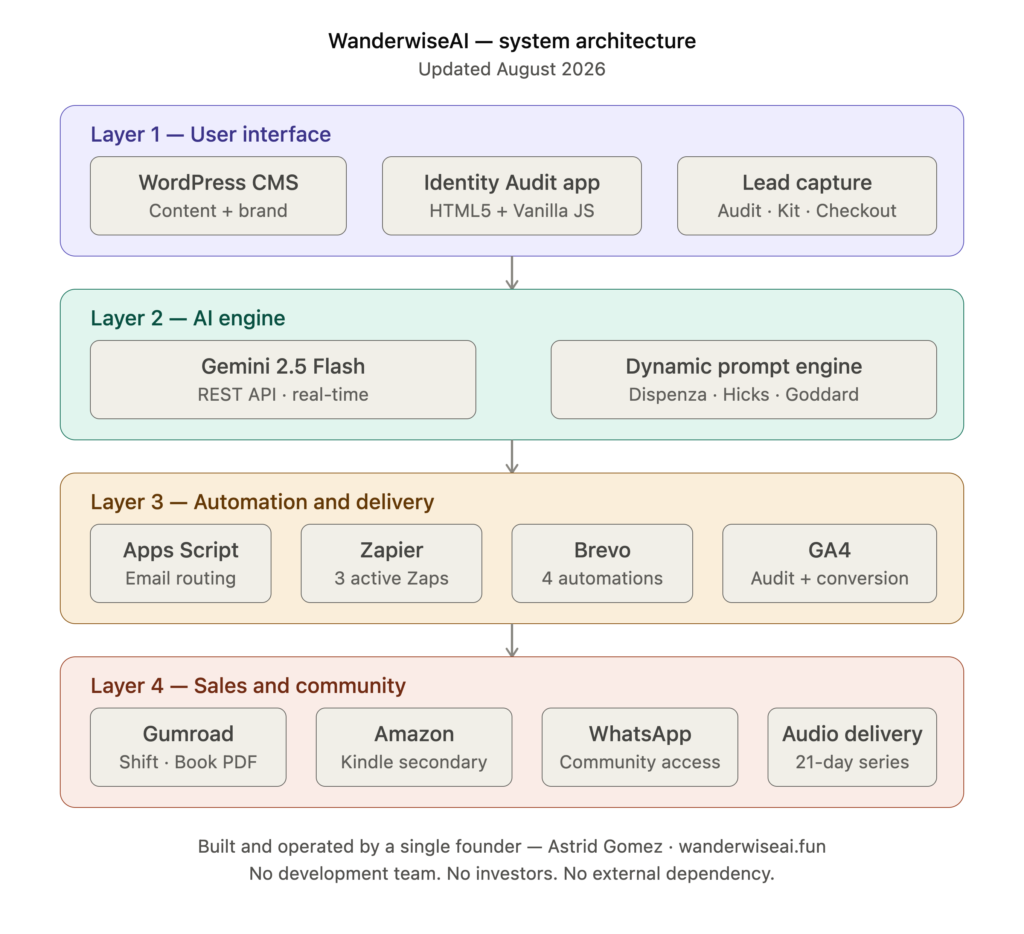
The platform operates across four distinct technical layers:
Layer 1 is the user interface — a WordPress CMS powering the content and brand environment, a custom-built AI application using HTML and Tailwind CSS, and lead capture forms managing the free kit, contact, and checkout flows.
Layer 2 is the AI engine — a Gemini 2.0 LLM integration with dynamic system prompt injection, personalising every interaction based on user-supplied data. The engine is tuned to the WanderwiseAI methodology and delivers contextual, structured responses at scale.
Layer 3 is the data persistence layer — Firebase Firestore handling real-time conversation history, Firebase Authentication managing anonymous multi-user sessions, and a cross-session user profile store that maintains personalisation state across visits.
Layer 4 is the delivery and conversion pipeline — MailerLite for automated email delivery (integration in progress), PayPal handling transactional checkout for The Shift program, Facebook Group for community access post-purchase, and direct audio delivery for the 21-day transmission series.
The AI Application — Identity Audit Engine
The Identity Audit is a live deployment of the WanderwiseAI AI engine. It is not a chatbot or a static quiz. It is a three-question diagnostic tool that collects structured user input, constructs a dynamic prompt with behavioural context, calls the Gemini API in real time, parses the structured response, and renders a personalised phase diagnosis — all within a single seamless user experience.
The tool demonstrates: LLM API integration, dynamic prompt engineering with structured output parsing, multi-user session management via Firebase anonymous authentication, cross-session data persistence, and a conversion-optimised UX flow from diagnosis directly to product checkout.
It was designed, built, and deployed without a development team.
Technical Stack at a Glance
Platform: WordPress CMS AI Engine: Google Gemini 2.0 Flash via REST API Frontend Application: HTML5, Tailwind CSS, Vanilla JavaScript Database: Firebase Firestore (real-time, NoSQL) Authentication: Firebase Anonymous Auth Email Automation: MailerLite (in integration) Payments: PayPal Community: Facebook Groups Methodology Frameworks: ITIL Service Design, Agile delivery, AI prompt engineering
What This Environment Represents
For organisations evaluating AI readiness, the most common gap is not ambition — it is demonstrated execution. Anyone can describe an AI strategy. Fewer can show a working system they built themselves.
WanderwiseAI exists as evidence of the latter. Every architectural decision made here — from the choice of Firebase over a traditional database, to the prompt engineering approach, to the conversion funnel design — reflects the same thinking applied to enterprise environments: link every technical decision directly to a measurable outcome.
The outcome here is a scalable digital product business. The same thinking scales to EBITDA.
Ready to experience the system in action? Run your Identity Audit →
